
Strong Through Menopause: Why Strength Training Matters More Than Ever
- TJ Martino

- 6 days ago
- 6 min read
For a lot of women, menopause feels like the rules changed overnight.
The workouts that used to “work” do not seem to move the needle anymore.
The scale feels stubborn.
Energy feels different.
Muscle tone feels harder to maintain.
Recovery takes longer.
And even when you are doing “all the right things,” it can feel like you are spinning your wheels.
You are not imagining it.
Around perimenopause and menopause, the body goes through real physiological changes. Hormones shift. Estrogen declines. Muscle mass becomes harder to maintain. Bone density becomes a bigger priority. Fat distribution can change, especially around the midsection. Recovery, sleep, stress, and metabolism can all feel less predictable.
That does not mean your body is broken.
It means your training needs to evolve.
And for many women, the missing piece is strength training.
Not random workouts.
Not endless cardio.
Not lighter weights forever.
Real, progressive, well-coached strength training.
Menopause Changes the Demands on Your Body
Menopause is not just about hot flashes or irregular cycles.
It is a major transition for muscle, bone, metabolism, and long-term health.
Research from the Study of Women’s Health Across the Nation, commonly known as SWAN, has shown that the menopause transition is associated with accelerated fat gain and loss of lean mass. That matters because lean muscle is one of the biggest drivers of strength, function, metabolism, balance, and long-term independence.
This is one of the reasons so many women say, “I’m doing the same things I used to do, but my body is not responding the same way.”
That may be true.
But the answer is not to punish yourself with more exercise.
The answer is to train for the adaptations your body actually needs.
Why Strength Training Is So Important Around Menopause
Strength training gives the body a signal.
A signal to build and maintain muscle.
A signal to keep bones strong.
A signal to improve balance, coordination, and joint support.
A signal to improve how your body handles glucose and uses energy.
A signal to stay capable.
As estrogen declines, the natural protection women once had for bone, muscle, and connective tissue begins to change. That makes strength training less of a bonus and more of a necessity.
The benefits go far beyond looking toned.
Strength training can help improve:
Muscle mass and strength
Bone density and bone strength
Joint support and pain resilience
Balance and fall prevention
Glucose control and metabolic health
Body composition
Confidence with movement
Long-term independence
And maybe most importantly, it helps women feel like their body is working with them again instead of against them.
Why Cardio Alone Usually Is Not Enough
Cardio is not bad.
Walking, cycling, running, hiking, rowing, and conditioning all have value. They support heart health, endurance, mood, and overall fitness.
But cardio alone usually does not provide enough stimulus to build meaningful muscle or maintain bone density.
That is where many women get stuck.
They are working hard.
They are sweating.
They are burning calories.
But they are not giving the body the mechanical load it needs to build strength, preserve lean mass, and protect bone.
That is why more cardio is not always the answer.
If your body is losing muscle, doing more workouts that do not build muscle may leave you frustrated.
If your bones need loading, exercises that do not challenge the skeleton may not create the adaptation you need.
If your metabolism is changing, chasing calorie burn without building muscle can feel like a losing game.
This is why so many women feel like they are doing a lot, but not getting stronger, leaner, or more confident.
The effort is there.
The strategy is missing.
Why Most Women Feel Like They Are Spinning Their Wheels
Most women are not failing because they lack discipline.
They are failing because the plan does not match the season of life they are in.
A lot of women around menopause are told to:
Eat less
Do more cardio
Take more classes
Use lighter weights
Avoid lifting heavy
Push harder when they are already exhausted
The problem is that none of that addresses the real issue.
You need a plan that builds strength, improves capacity, supports recovery, and respects where your body is right now.
Most group classes are not individualized enough.
Most cardio programs are not strength-focused enough.
Most generic strength plans are not built with menopause in mind.
And most women are never taught how to progressively lift in a way that is safe, effective, and sustainable.
So they bounce between workouts, try harder, get frustrated, and start to believe their body just does not respond anymore.
But that is not true.
Your body can still respond.
It just needs the right signal.
The Research Is Clear: It Is Never Too Late
One of the biggest misconceptions around menopause is that once strength, muscle, or bone density starts to decline, it is too late to do anything about it.
That is not what the research shows.
Studies on resistance training in middle-aged and postmenopausal women consistently show improvements in strength, body composition, physical function, and bone health when training is done consistently and progressively.
One of the most well-known examples is the LIFTMOR trial, which studied high-intensity resistance and impact training in postmenopausal women with low bone mass. The women in the supervised strength training group improved measures of bone strength and functional performance.
That matters because it shows that the body can still adapt.
Even after menopause
Even if you have not lifted before
Even if you feel behind
Even if you have tried other things and felt like nothing worked
The goal is not to train like a 25-year-old.
The goal is to train in a way that helps your body become stronger, more resilient, and more capable now.
Strength Training Does Not Have to Be Intimidating
A lot of women know they “should” lift weights, but they do not know where to start.
They are unsure what exercises to do.
They worry about getting hurt.
They feel uncomfortable in a gym.
They do not know how heavy is heavy enough.
They are not sure how to modify around knee pain, back pain, shoulder pain, pelvic floor symptoms, fatigue, or old injuries.
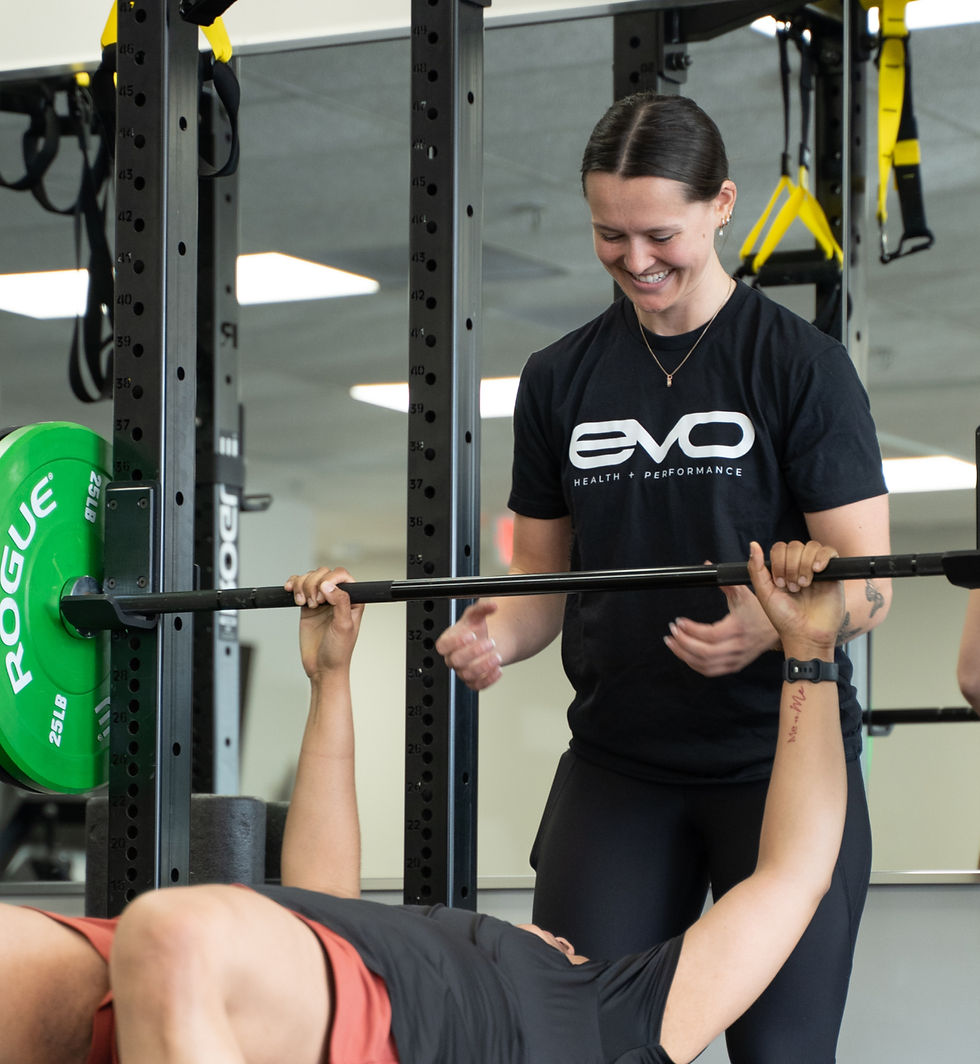
That is exactly why coaching matters.
Strength training around menopause should not be random.
It should be structured.
It should meet you where you are.
It should teach you how to move well, lift safely, progress gradually, and build confidence over time.
Because the goal is not just to exercise.
The goal is to create the adaptations your body needs.
How EVO Helps Women Get Strong Through Menopause
At EVO, we built our 6-Week Strong Through Menopause Program for women who are tired of guessing.
This program is designed to help you build strength, improve confidence, and finally feel like your workouts are working for you again.
We focus on the things that matter most around menopause:
Building lean muscle
Improving bone-loading tolerance
Training balance and coordination
Supporting joint health
Improving movement quality
Creating sustainable consistency
Helping you understand how to progress safely
This is not a random collection of workouts.
It is a structured plan built around strength, education, and support.
You will learn what to do, how to do it, and why it matters.
Because menopause should not be the beginning of feeling weaker.
It can be the moment you decide to train differently.
You Are Not Behind
If you are in your 40s, 50s, 60s, or beyond and feel like you missed your window, you have not.
It is never too late to get stronger
It is never too late to build muscle
It is never too late to improve balance, confidence, and resilience
It is never too late to start taking your long-term health seriously
But the plan has to match the goal.
If you want stronger muscles, you need strength training.
If you want stronger bones, you need progressive loading.
If you want better balance and confidence, you need to train coordination and control.
If you want your body to feel different, your training has to create a different adaptation.
That is what strength training does.
And that is what we help you build.
Ready to Stop Spinning Your Wheels?
If you feel like you have been doing the work but not getting the results, this is your next step.
Our free 6-Week Strong Through Menopause Program is built to help you train smarter, build strength, and feel more confident in your body through menopause and beyond.
This is not about chasing quick fixes.
It is about building the foundation your body needs for the next decade of life.
Click here to start the free 6-Week Strong Through Menopause Program.


Comments